Maybe you know this feeling:
You are actually doing “everything right”.
You eat reasonably healthily, try to avoid stress, sleep enough (most of the time) – and yet your body doesn't really feel good.
Something doesn't add up.
You are tired even though you slept.
Your stomach reacts sensitively.
Your mood fluctuates.
Your head is full.
And somewhere deep inside you think:
“There has to be more to it.”
Spoiler: Yes.
And right here comes holistic health into the game.
Because your body is not made up of individual construction sites.
It is not a puzzle with isolated pieces.
He is a system – and everything is connected.
⭐ What does “holistic health” really mean?
Holistic health does not mean:
- just eat healthy
- just think positively
- just meditate
- just do sports
Holistic health means:
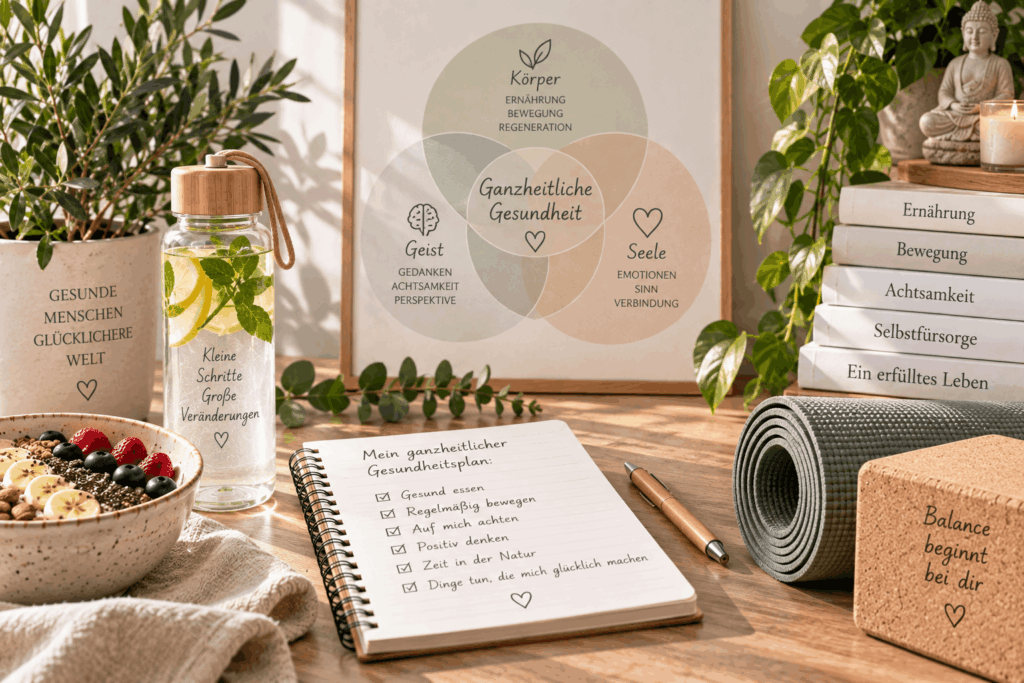
👉 To view body, psyche, nervous system, intestines, hormones, emotions, everyday life and thoughts as a unit.
Not separated.
Not isolated.
Not with the thought: “I’m just going to fix this one problem.”
But with the question:
“What is my body trying to tell me as a whole?”
Why symptom-oriented thinking is often not enough
Many people treat symptoms like individual noises:
- Headache → tablet
- Bloated stomach → leave it out
- Tiredness → coffee
- Stress → persevere
- Sleep problems → ignore
The problem:
Symptoms are rarely the actual problem.
They are messages.
Your body is calling for a reason.
He whispers first.
If you don't listen, it gets louder.
Holistic health therefore not only asks:
❌ “What hurts?”
rather:
✅ “Why does it hurt?”
The body is a system – not an accident
Let's look at a few typical connections that many people underestimate:
- Stress → intestinal problems
- Intestinal problems → mood swings
- Lack of sleep → hormone imbalance
- Hormone imbalance → exhaustion
- Exhaustion → poorer digestion
- Poor digestion → nutrient deficiencies
- Nutrient deficiencies → mental instability
👉 A cycle. Not a coincidence.
So if you only tinker with one area but ignore the system, change often remains superficial.
Intestines, head and nervous system – an unbeatable team
Your intestines are not only responsible for digestion.
He is:
- your immune center
- your mood manager
- your stress sensor
- your energy regulator
About the so-called Gut-brain axis it is in constant communication with your brain.
For this reason:
- stress hits your stomach
- the gut influences your mood
- Fear changes digestion
- Exhaustion affects your eating habits
Holistic health here means:
👉 Not “either body or mind” – but both at the same time.
Why stress is almost always the invisible trigger
Stress isn’t just “having a lot to do.”
Stress is:
- internal pressure
- perfectionism
- emotional overload
- unresolved conflicts
- constant functioning
- missing breaks
And stress has a direct effect on:
- your nervous system
- your hormones
- your intestines
- your immune system
You can eat perfectly –
If your nervous system is constantly in alarm mode, your body still won't calm down.
Holistic health therefore always asks:
“How safe does your body feel right now?”
Hormones, emotions & everyday life – more connected than expected
Hormones react sensitively to:
- Sleep
- stress
- Nutrition
- Thoughts
- emotional stress
If you constantly go beyond your limits, your body shows it – often hormonally:
- Cycle problems
- exhaustion
- irritability
- Sleep disorders
- Weight fluctuations
Thinking holistically here means:
👉 Not to work against the body, but with it.
Why “doing everything right” is often the problem
Many people who are interested in health are very strict with themselves:
- perfect nutrition
- perfect routines
- perfect discipline
- perfect control
But the body doesn't love perfection.
He loves Security, regularity and relaxation.
Holistic health also means:
- less pressure
- more compassion
- more breaks
- more listening
The 5 pillars of holistic health
If you want to break it down, holistic health is based on these five pillars:
1️⃣ Body (diet, exercise, sleep)
2️⃣ Intestines & Digestion
3️⃣ Nervous system & stress regulation
4️⃣ Psyche & Mindset
5️⃣ Everyday life & lifestyle
No pillar works alone.
If one wobbles, the whole thing wobbles.
Why small changes often bring more results than big plans
Holistic health does not come from radical changes.
But through small, constant impulses:
- 10 minutes of rest
- conscious eating
- better sleep
- honest breaks
- less self-criticism
Your body doesn't need a revolution.
He needs reliability.
Holistic health is not a trend – it is a reconnection
It's not about becoming “even healthier”.
It's about, to get back in touch with yourself.
Your body knows what it needs.
You just forgot how to listen to him.
Holistic health is therefore not a goal.
It is a path.
A dialogue.
A relationship with yourself.
Why healing sometimes takes time – and that's not a step backwards
A very important point that many underestimate:
Holistic health isn't a switch you just flip. Your body works in cycles, not to-do lists. Some changes you feel immediately, others take weeks or months – and both are completely normal. Healing is rarely linear. There are days when you feel great and others when old symptoms briefly return. This doesn’t mean you’re “back to square one.” It means your body is processing, regulating and relearning.
Especially people who are very reflective or have had problems for a long time often expect too much of themselves. But your body needs one thing above all: Patience and security. The less pressure you put on yourself, the better your nervous system can relax – and that is exactly the basis for real, sustainable health.
Living a holistically healthy life begins with trust
In the end it all comes down to one central question:
Do you trust your body – or are you constantly fighting against it? Holistic health means reshaping this relationship. No longer working against symptoms, but with them. To no longer want to control everything, but to feel what is really good for you again. Your body is not your opponent. He is your partner. And the better you understand each other, the easier your everyday life will feel.
When you start listening to your body instead of optimizing it, something very valuable arises: peace. Clarity. Confidence. And that's exactly where real health grows – step by step, at your own pace, without pressure.
Conclusion: When you start thinking holistically, everything changes
You are not complicated.
Not broken.
Not “too sensitive”.
You are a person with a complex system –
and this system wants to be seen.
As soon as you start to understand connections, something new emerges:
- more peace
- more clarity
- more trust
- more well-being
👉 Because everything is connected. And you are part of this whole thing.
If you feel that your body has been trying to tell you something for a long time, then you have come to the right place.
I accompany you on your path to greater well-being, inner balance and holistic health – step by step, without pressure and without perfection.