Let's be honest. How often do you sit on the sofa in the evening with a stomach that feels like you've swallowed a medicine ball even though you've only eaten a salad? You're constantly tired, your skin is acting up, and you feel like you're fighting against windmills because no one can figure out what's wrong with you. You run from doctor to doctor, but all you get is a tired smile and advice to “stress less.” You don't know that yet? Then congratulations! But for many of us, that is the grueling reality.
I know this all too well. For years I thought it was all just my imagination. The constant exhaustion, the concentration problems (hello, “brain fog”!), the sudden food intolerances and digestion that did whatever it wanted. I was caught in a cycle of overwhelm and the fear of simply not being able to cope with my everyday life. Until I came across three small but powerful words that would change everything: Leaky gut syndrome.
That sounds like something out of a bad science fiction movie, right? A “holey gut”. But no one believes me when I tell you how real this problem is and how many of us suffer from it unconsciously. Today I'll take you by the hand and together we'll look at what's really behind this phenomenon and how you can regain control over your body with simple but incredibly effective nutritional tips.
What is a leaky gut anyway? Your intestines as a leaky bouncer
Imagine your gut wall like the most organized bouncer at an exclusive club. He has a tough guest list. Only the really important people – nutrients, vitamins and minerals – are allowed into your bloodstream. Anyone else who could cause trouble, such as toxins, undigested food particles and nasty bacteria, will be rigorously rejected and escorted straight to the exit (i.e. with the stool).
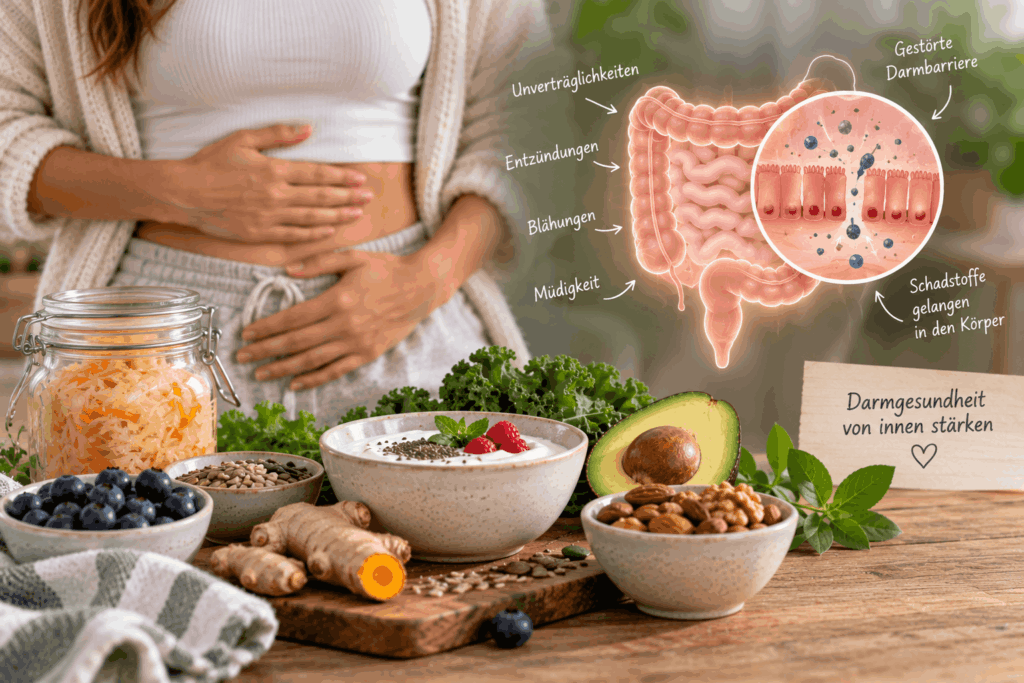
With leaky gut syndrome, this bouncer basically quit. The tight connections between the cells in your intestinal lining (the so-called “tight junctions”) become loose. Suddenly the doors are wide open and every rioter can walk unhindered into your bloodstream. Your immune system immediately sounds the alarm because it recognizes these intruders as enemies. The result? A constant loop of inflammation throughout the body. And it is precisely these silent inflammations that are the root of many of the evils that make our lives so difficult.
Possible symptoms that could indicate leaky gut:
- Chronic digestive problems such as bloating, diarrhea or constipation
- Constant tiredness and exhaustion that doesn't go away even after 8 hours of sleep
- Skin problems such as acne, eczema or rosacea
- Food intolerances that suddenly appear out of nowhere
- Joint pain and muscle pain
- Difficulty concentrating and “brain fog”
- Mood swings and even depressive moods
- Autoimmune diseases such as Hashimoto's or rheumatoid arthritis are often associated with it
Do you recognize yourself? No panic! You are not alone and above all, you are not powerless.
The Real Culprits: What Makes Your Gut Leaky
A leaky gut rarely happens overnight. It is usually the result of a combination of several factors that affect your intestines over a long period of time. The most common causes are:
- Chronic stress: Oh yes, our old friend. Constant stress releases the hormone cortisol, which can directly weaken the intestinal barrier.
- Unhealthy diet: Lots of sugar, processed foods and unhealthy fats feed bad gut bacteria and promote inflammation.
- Medication: Frequent use of antibiotics or painkillers (such as ibuprofen) can attack the intestinal lining.
- Dysbiosis: A fancy word for an imbalance in your intestinal flora. When the bad guys get the upper hand, they damage the intestinal lining.
- Gluten: In some people, gluten can release a protein called zonulin, which opens the “doors” of the intestinal wall.
Heal your gut: 5 nutrition tips that really make a difference
The good news is: your intestines are a regeneration miracle! With the right building blocks, you can help him rebuild his protective wall. Nutrition is your most powerful tool.
Tip 1: Bone broth – liquid gold for your intestinal wall
This might sound like grandma's medicine cabinet at first, but no one will believe me about what a superfood bone broth is! Bone broth cooked for a long time (preferably 12 hours or more) releases incredibly valuable nutrients, especially Collagen and gelatin.
These substances are like a balm for your holey intestinal wall. They provide the amino acids glycine and proline, which act as a “mortar” to close the gaps in the intestinal barrier and relieve inflammation. I often start my day with a warm cup of broth instead of coffee. It was a change at first, but my stomach thanked me!
My personal recommendation: At first I was too lazy to cook broth for hours. That's why I got a high quality one Collagen powder worried. I just stir this into my tea or smoothie in the morning. It is tasteless and a super easy way to supply my intestines with the necessary building blocks every day. Pay attention to good quality without unnecessary additives!
Tip 2: L-Glutamine – The power amino acid for your intestinal cells
If bone broth is the mortar, then L-glutamine is your intestinal cells' absolute favorite food. This amino acid is the primary source of energy for the cells of the intestinal lining, helping them to quickly regenerate and repair. Studies suggest that L-glutamine may help strengthen the intestinal barrier and reduce permeability.
I have integrated L-glutamine as a powder into my routine, especially during stressful periods. A teaspoon in a glass of water before breakfast – a small habit with a huge impact. It helped me manage the constant bloating and cramps.
Tip 3: Probiotics & Fermented Foods – Get the good guys on board!
You need to replenish your army of good gut bacteria so they can fight off the bad guys. Probiotics are live microorganisms that do just that.
You can find them in fermented foods like:
- Sauerkraut (unpasteurized!)
- Kimchi
- Natural yogurt or kefir (if you tolerate dairy products)
- Kombucha
I love having a small forkful of sauerkraut with my lunch. This is not only delicious, but also a feast for my good intestinal bacteria. When starting with fermented foods, start slowly as you may experience some bloating at first.
Additional tip: A high quality one Probiotic as a capsule can work wonders in the beginning. Look for a product with many different bacterial strains (e.g. lactobacilli and bifidobacteria) to ensure broad support. I always take mine on an empty stomach at night before going to bed.
Tip 4: Anti-inflammatory on the plate – Omega-3 fatty acids
Chronic inflammation is the driving force behind leaky gut. So we have to put out the fire! Omega-3 fatty acids are true superheroes when it comes to reducing inflammation in the body.
Put these foods on your plate regularly:
- Fat fish: Salmon, mackerel, herring
- Flaxseed oil and flaxseed: Perfect for salads or smoothies
- Walnuts and chia seeds: Great as a snack or in muesli
I had really bad joint pain for a while that I never would have associated with my gut. Since I consciously pay attention to a high intake of omega-3 and also a good one Omega-3 fish oil capsule supplement this pain has almost disappeared. Nobody believes me, what a difference it makes!
Tip 5: Leave out what is harmful – avoid the 3 big triggers
As important as adding good things is eliminating the things that stress your gut. For a healing phase of at least 4-6 weeks, I recommend that you consistently avoid the three biggest potential troublemakers:
- Gluten: Even if you don't have celiac disease, gluten can irritate the intestinal wall.
- Dairy products: Many people with intestinal problems have difficulty with lactose or the milk protein casein.
- Refined sugar: It is the favorite food of bad bacteria and increases inflammation.
Yes, that sounds harsh at first. But think of it as an experiment. A gift to your body. You give him a chance to recover without having to constantly fight new attacks.
Q&A: Your most burning questions about leaky gut
1. How long does it take for my gut to heal?
- Pain point: “I’ve tried so many things and I’m afraid it’ll never get better.”
- Solution: Be patient with yourself! The intestinal lining renews itself relatively quickly, but healing leaky gut is a marathon, not a sprint. Give yourself at least 3-6 months of consistent diet changes and the right nutrients. But you will probably notice the first positive changes after just a few weeks!
2. Do I have to give up gluten and dairy forever?
- Pain point: "Oh my God, never pizza or cheese again? I'll never be able to do that!"
- Solution: Not necessarily! It's about giving the intestines a break to heal. After the strict initial phase, you can try slowly reintroducing high-quality fermented dairy products (like organic yogurt) or gluten-free alternatives and see how your body reacts. It's best to keep a symptom diary.
3. How do I find out if I really have leaky gut?
- Pain point: “My doctor doesn’t take me seriously, I feel helpless.”
- Solution: While conventional medicine often neglects the topic, there are tests that can provide clues. A Zonulin test in stool or blood can measure the permeability of the intestinal wall. It's best to speak to a naturopath or a functional medicine doctor about this.
Conclusion: You have the power to heal your gut (and your life)!
If you have read this far, then you now know that you are not helpless at the mercy of your diffuse symptoms. A leaky gut is not your imagination, but a real, physical problem that you can actively address. It's the loving but firm kick in the bottom that your body gives you to finally take a look.
Listen to your gut. Feed him the things that make him strong: nourishing bone broth, healing L-glutamine, an army of good probiotics, and anti-inflammatory fats. Be brave and leave out what harms him. You will be amazed at how much energy, joy of life and well-being you regain.
Nobody believes me, but the path to better health really begins in the gut. You can do it!
P.S.: Do you want to delve even deeper into the world of gut health? Then take a look at my following articles: