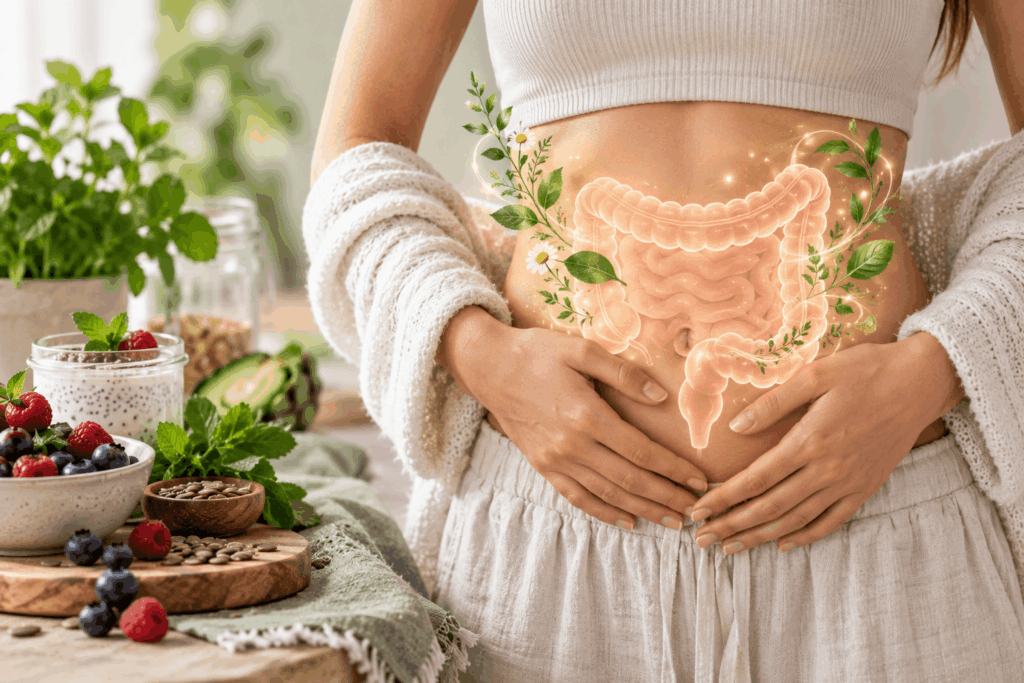
If your gut could talk, it would probably say:
"Hey… I'm trying to tell you something here all the time! Why don't you ever listen?"
And the amazing thing is:
He speaks really with you.
Every day.
With every grumble, every tug, every tiredness after eating, every stress tummy ache and every feeling like you're about to burst even though you've barely eaten anything.
Your intestines are not just an organ.
He is your inner warning system, your emotional thermometer, your immune center, your hormone manufacturer and quite often the honest friend who tells you:
“The way you’re living right now doesn’t do me any good.”
Today we'll look at it together, What what your gut wants to tell you – and why it's so important to finally listen.
Why your gut is so much more important than you think
Most people still believe that the intestine is simply a “digestive tube.”
A little bit of food in, a little bit of digestion, a little bit of stuff that you don't mention.
But your gut is a complete ecosystem.
A world of your own.
A universe within you.
Did you know that:
- your intestines over 100 trillion bacteria contains?
- he has more nerve cells than your spinal cord?
- 90% of the happiness hormone serotonin produced in the intestine?
- 80% of your immune system sitting in the intestines?
- does your intestines react to stress in seconds?
- your gut constantly communicates with your brain?
That means:
👉 Gut health is not just digestion.
Gut health is quality of life.
Mood. Energy. Sleep. Skin. well-being. Hormones. Even decisions.
When your gut is out of balance, your entire life is out of balance.
And you'll notice that much quicker than you think.
The connection between the stomach and the head: the gut-brain axis
Maybe you have already experienced:
- Stress → stomach cramps
- Argument → nausea
- Exam anxiety → diarrhea
- Overwhelm → bloated stomach
- Exhaustion → loss of appetite
This is not imaginary.
It's biology.
Your gut and your brain communicate via the vagus nerve, hormones and electrical signals constantly interact with each other.
This system is called:
👉 The gut-brain axis.
It's an emotional highway between your gut and your head — both driving at the same time.
When your head is stressed, your gut is affected.
When your intestines are inflamed, your psyche reacts.
That's why this deep feeling in the stomach often arises before you understand it rationally.
Your gut is faster than your mind.
13 signs your gut is trying to tell you something
Both physical and emotional signals come here:
1. Constant bloated stomach
Whether it's morning, noon or evening, your stomach tenses up as if you've swallowed a watermelon.
2. Tiredness after eating
Your body fights – instead of digesting.
3. Mood swings
A dysbalanced microbiome affects your neurotransmitters.
4. Fears or inner restlessness
The intestine is directly involved in the stress system.
5. More severe PMS symptoms
Intestinal inflammation increases hormonal fluctuations.
6. Pain or cramps
A clear cry for help.
7. Frequent headaches
Very often associated with the intestines.
8. Skin problems
Pimples, eczema – inflammation often comes from the intestines.
9. Sleep problems
Bad gut → less serotonin → bad sleep.
10. Sugar cravings
These are not your Cravings – these are the bacteria.
11. Problems with concentration
Brain fog due to inflamed intestinal mucosa.
12. Intolerances develop suddenly
A sign of compromised intestinal flora.
13. Stress hits you IMMEDIATELY on your stomach
The vagus nerve is hypersensitive.
If you recognize yourself in several ways, it's no coincidence.
It just means: Your body speaks to you.
The biggest enemies of your intestinal health
1. Chronic stress
It increases cortisol → cortisol weakens the intestinal barrier → bacteria become unbalanced → inflammation occurs.
In short:
👉 Stress causes chaos in the intestines.
2. Poor sleep
Even 1 bad night changes the composition of your intestinal flora.
Your intestines love routine and a good night’s sleep.
3. Too little fiber
are fiber food for good intestinal bacteria – without them your microbiome starves.
4. Antibiotics (including old intakes!)
Many people underestimate that.
Antibiotics can weaken the microbiome for months.
5. Constant emotional stress
perfectionism
Pressure
Self-doubt
“I have to be strong”
Emotional stress → physical stress → intestinal stress.
6. Sugar and highly processed foods
They promote inflammation and “feed” unfavorable bacteria.
7. Intolerances that are not recognized
Fructose, histamine, lactose, gluten, sorbitol – if left untreated, they put enormous strain on them.
⭐ The 10 foods your gut loves
- Oats
- linseed*
- Bananas
- Blueberries
- Natural yogurt or kefir (if tolerated)
- sauerkraut
- Lenses
- Almonds
- broccoli
- Whole grain products
These foods nourish you good Bacteria.
The 10 foods your gut avoids
- Sugar
- alcohol
- white flour
- Fast food
- ready meals
- spicy additives
- Artificial sweeteners
- Histamine-rich foods (for intolerances)
- large meals under stress
- Dairy products (if intolerable)
Emotional Truth: Your gut responds to your life, not just your food
Maybe you know this:
- You eat healthy → your stomach is still spinning
- You do everything “right” → still have problems
- You are disgusted by some foods
- Your stomach tightens under stress
- You often have “a bad feeling in your stomach”
This is because your intestines emotionally storeswhat you don't process:
- Conflicts
- Grief
- Fury
- Fear
- Overwhelm
- exhaustion
The intestines carry your internal load before you are consciously aware of it.
And that's why some complaints feel so deep — because they ARE.
The 4-step gut healing model
Step 1: Bring calm
Your nervous system determines 40% of how your intestines work.
Tools:
- Deep breaths
- 10 minute walk
- Cell phone away while eating
- conscious breaks
- hot water bottle
Step 2: Strengthen intestinal flora
With:
- fermented foods
- Prebiotics
- fiber
- bitter substances
- enough water
Step 3: Recognize triggers
e.g. E.g.:
- stressful moments
- Groceries
- Lack of sleep
- hormonal fluctuations
You don't have to avoid everything – just understand it.
Step 4: Develop long-term routines
Routines make healing stable:
- 1 fiber-rich meal daily
- Breathe deeply for 2 minutes
- 5-10 minutes of exercise
- switch off earlier in the evening
- 1 relaxing ritual per week
Mini intestinal reset plan: 7 days to greater well-being
Day 1 – Observe instead of evaluating
What is good for you?
What not?
Day 2 – Eat lighter
Soups, oats, vegetables, bananas.
Day 3 – Reduce stress
5 minutes of breathing exercises.
Day 4 – Increase fiber
Flax seeds, berries, oats.
Day 5 – Improve sleep
Screen off earlier in the evening.
Day 6 – Drink consciously
1.5-2 liters.
Day 7 – Gut dialogue
Hand on stomach:
"What do you need from me today?"
To keep my gut reset plan going, I have this diary* used what really helped me stick with it!
Personal experience (for closeness & trust)
I'll write you something honestly:
I ignored my gut for a long time.
I thought a little bloating was “normal”.
Fatigue is “part of my life”.
Restlessness is “just stress”.
But my gut tried to tell me years before:
“It can’t go on like this.”
And when I started listening to him, everything changed:
- My energy level
- My mood
- My digestion
- My eating habits
- My stress level
- My sleep
It was like my body was saying:
"Finally. You hear me."
Today I know:
Gut health is self-love.
FAQ – Frequently asked questions about intestinal health
1. What is more important: diet or stress?
Both are important — but stress is often the bigger factor.
2. Can intolerances disappear as the gut heals?
Yes — many become weaker or disappear completely.
3. How long does intestinal healing take?
From a few weeks to several months.
It's a process — not a sprint.
4. Do I need expensive probiotics?
Not necessarily. Food first.
Probiotics only targeted.
5. Is a bloated stomach normal?
No – it is a sign.
6. Why do I have a stomach ache when I'm stressed?
vagus nerve. Nervous system. Adrenaline.
Just normal biology.
Conclusion: Your gut is your greatest teacher
Your gut is not against you.
He protects you.
He feels for you.
He warns you.
He shows you what you need.
When you start listening to him, your whole life changes:
More energy.
More peace.
More clarity.
More well-being.
Gut health is not complicated —
it is a loving dialogue with yourself.
If you feel like your gut is trying to tell you something, then you've come to the right place.
I'll accompany you step by step on your way to a healthy gut feeling, more energy and a life that finally feels easy again.