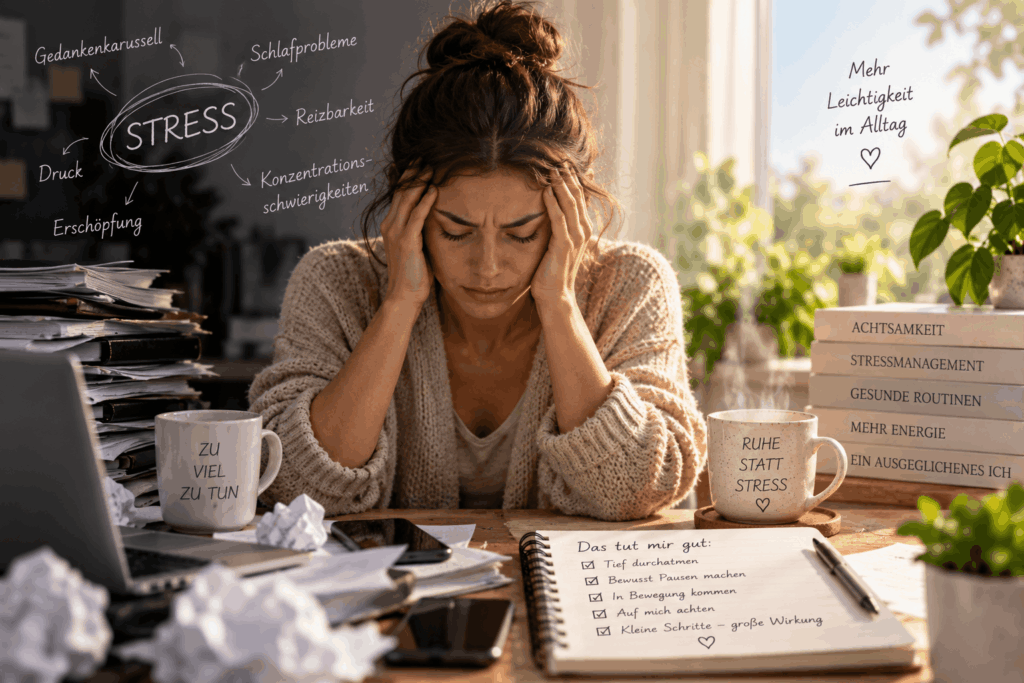
Long-term stress rarely manifests itself on just one level. Mostly it concerns Body, psyche and emotions at the same time. That's exactly what makes him so difficult to grasp.
Constant stress and the nervous system – what really happens in the body
To understand long-term stress, you have to look at the nervous system. To put it simply, our autonomic nervous system consists of two counterparts: the activation mode and the relaxation mode.
Under constant stress, the body remains permanently in activation mode. That means:
- The pulse is increased
- Breathing becomes shallower
- Muscles remain tense
- Digestion and regeneration are shut down
This is helpful in the short term. In the long term, however, exhausting. The body no longer receives enough signals that it is safe to let go.
Many affected people report exactly this:
“I want to relax – but my body isn’t cooperating.”
This is not a personal failure; physiological reaction to persistent stress.
Physical symptoms of constant stress
The body is often the first to sound the alarm:
- chronic fatigue
- Sleep problems or unrefreshing sleep
- Headache or migraine
- Neck, shoulder or back pain
- Gastrointestinal complaints
- frequent infections
- Heart palpitations or inner restlessness
These symptoms often appear unspecific – but are clear signals of stress.
Psychological symptoms of chronic stress
Long-term stress also leaves clear marks mentally:
- Difficulty concentrating
- circles of thought
- rapid overload
- irritability
- forgetfulness
- inner drive
Many people feel “beside themselves” or constantly under pressure.
Emotional symptoms of chronic stress
The emotional consequences are particularly stressful – and often taboo:
- emotional exhaustion
- Numbness or emptiness
- Loss of joy
- Withdrawal from social contacts
- Feeling guilty when taking breaks
The feeling of never really being able to switch off becomes a permanent condition.
Causes of chronic stress: Why so many are affected
Long-term stress is rarely caused by a single cause. It is usually a combination of external demands and internal pressure.
High demands in everyday life
Career, studies, self-employment, family – many people have too much responsibility on a permanent basis. Breaks are postponed and relaxation becomes secondary.
Not out of weakness, but out of a sense of duty.
Internal pressure to perform and perfectionism
A large part of the stress arises in your own head:
- “I have to function.”
- “I can’t afford to make any mistakes.”
- “I can’t be weak.”
This inner driver ensures that even periods of rest are internally stressful.
Constant availability and overstimulation
Smartphone, social media, news, to-do lists – the nervous system hardly gets any real rest. Even breaks are often filled with stimuli.
The problem: There is no regeneration without a stimulus break.
Permanent emotional stress
Unsaid conflicts, unresolved issues, emotional insecurity or old stress patterns often have an effect in the background – permanently and unnoticed.
The body stores this tension.
Lack of boundaries
Many people have never learned to set clear boundaries:
- Say no
- Request breaks
- take your own needs seriously
Boundaries feel uncomfortable – but they are essential for reducing stress.
What constant stress does to the body
Constant stress is not a purely psychological issue. It changes processes throughout the body:
- permanently elevated stress hormones
- disturbed sleep and regeneration processes
- weakened immune system
- hormonal imbalances
- increased susceptibility to inflammation
In the long term, constant stress can create the basis for serious health problems. That's why early countermeasures are so important.
Constant stress in everyday life: Why we often recognize it too late
Many people only realize very late that they are under constant stress. Not because they aren't paying attention – but because constant stress begins gradually. It doesn't come with a bang, but with small changes that are easy to miss.
At first it might just be a little less energy. Then comes bad sleep. You get irritated more easily, but you blame it on external circumstances. Everyday life goes on, the to-do list gets longer and breaks are increasingly postponed until “later”.
The problem:
The longer this condition lasts, the more the body adapts to the stress. Stress is becoming the new normal. This is precisely why many people only recognize chronic stress when physical or emotional symptoms become clear.
Why constant stress often leads to exhaustion
Constant stress consumes resources. And every day. Without sufficient regeneration, an energy deficit arises – physically and mentally.
Typical consequences:
- Exhaustion despite rest periods
- Feeling of inner emptiness
- lack of motivation
- reduced resilience
What's particularly tricky is that many people try to compensate for this exhaustion with even more discipline. They keep pushing themselves, ignoring warning signs and thus exacerbating the stress cycle.
The body doesn't need more power – it needs Security and relief.
Constant stress in women – why they are often particularly affected
Women are disproportionately affected by constant stress. This is not due to a lack of resilience, but rather to structural and emotional factors.
Many women:
- take emotional responsibility
- organize and plan for others
- put your own needs aside
- have high standards for themselves
In addition, there are hormonal fluctuations that can further influence the stress system. Chronic stress in women often manifests itself in the form of:
- cycle problems
- Sleep disorders
- emotional exhaustion
- inner unrest
The same applies here: These are not “imaginations”, but real stress reactions of the body.
Constant stress and sleep – an underestimated connection
Sleep problems are one of the most common symptoms of chronic stress. Many of those affected are exhausted in the evening – but still awake inside.
Typical are:
- Problems falling asleep
- waking up at night
- Pondering
- not restful sleep
The reason: A stressed nervous system cannot simply switch off at the push of a button. That's why sleep hygiene is important – but often not sufficient unless stress is reduced during the day.
Relief during the day is the basis for better sleep at night.
Why breaks often don't help with constant stress
A common misconception:
“I just need a vacation.”
Breaks are important – but they are often not the solution when you are under constant stress. Many people notice on vacation:
- The unrest remains
- Thoughts keep circling
- There is no real relaxation
This is because constant stress is not a time problem, but rather a problem Regulation problem. The body has forgotten how to switch to relaxation mode.
That's why it needs:
- regular small reliefs
- new stress patterns
- more security in everyday life
Not just once a year – but continuously.
What really helps with constant stress
The good news: constant stress can be changed.
The honest truth: It takes more than quick tips.
Calm the nervous system – the most important step
As long as your nervous system is in alarm mode, many measures will not work.
The following are helpful:
- slow, conscious breathing
- regular breaks without stimuli
- gentle relaxation routines
Just a few minutes a day can regulate the system in the long term.
Identify causes instead of fighting symptoms
Ask yourself honestly:
- What is constantly stressing me out?
- Where do I exceed my boundaries?
- What robs me of energy?
Stress reduction doesn't start with to-do lists – but with clarity.
Learn to set boundaries
Boundaries are not egoism, but self-protection.
That means:
- not always available
- Don't justify breaks
- Share responsibility
The clearer your boundaries, the calmer your nervous system.
Prioritize sleep and regeneration
Sleep is not an afterthought.
Helpful:
- fixed bedtimes
- Evening routines without screens
- Relief at the end of the day
- less pressure to perform when falling asleep
Regeneration begins long before bedtime.
Make nutrition stress-friendly
When under constant stress, the body needs stability:
- regular meals
- enough protein
- nutrient-rich foods
- little sugar and heavily processed foods
Nutrition is not a substitute for recovery – but it supports it enormously.
Allow emotional relief
Stress doesn't go away if you ignore it.
May be helpful:
- Journaling
- Conversations
- Coaching or therapeutic support
You don't have to carry this alone.
Why “just relaxing” doesn’t work
Many people fail not because of a lack of motivation – but because of false expectations.
Constant stress requires:
- Security instead of pressure
- Understanding instead of self-criticism
- small steps instead of radical changes
Your body learns step by step that relaxation is safe again.
Constant stress is not a personal failure
Very important:
Constant stress is not a sign of weakness.
It is often the result of having been strong for too long.
And that's exactly why you can start taking yourself seriously now.
Conclusion: Long-term stress can be changed
Constant stress often feels hopeless. But it is not a fixed state. The sooner you start looking and making small changes, the greater the impact.
You don't have to be completely exhausted to allow yourself relief.
Your body sends signals – and they deserve attention.