If you've ever thought about a completely innocent apple: "Oh my God, that's it. I'm going to bury myself in bed.", then you've come to the right place.
And believe me, I'm not just saying that – I was a team member for a long time “What the hell is my stomach doing?” and seriously thought I was the only one killed by half a piece of fruit.
At that time I was sitting in a café with a friend, feeling super healthy, ordered a smoothie and thought I was doing something good for my body.
Well… two hours later I was curled up on the couch, holding my stomach like I'd swallowed a bowling ball.
Nobody believes me – but this smoothie was my final opponent.
And do you know what bothered me the most back then?
Not the pain.
Not the flatulence.
Not that “my belly is suddenly 6 months pregnant” feeling.
But this one sentence in my head:
👉 "I can't enjoy anything anymore. Everything causes problems. I constantly have to do without."
And right here I'm grabbing your hand now.
Let's turn the topic around completely for you – without panic, without the trauma of giving up, without this feeling of being excluded.
What is fructose intolerance – and why does it feel so unfair?
In short:
Your small intestine doesn't like fructose.
He doesn't take it in properly because the transporter who is supposed to do it acts as if he had the day off.
So the fructose ends up in the large intestine.
It is mined there.
And yes – this creates gases. Not the sweetest info, but you know it's true.
You can even look completely healthy, feel fit – and still lie on the sofa like a sip of water after eating a piece of fruit.
The symptoms – and why they sometimes completely screw you over
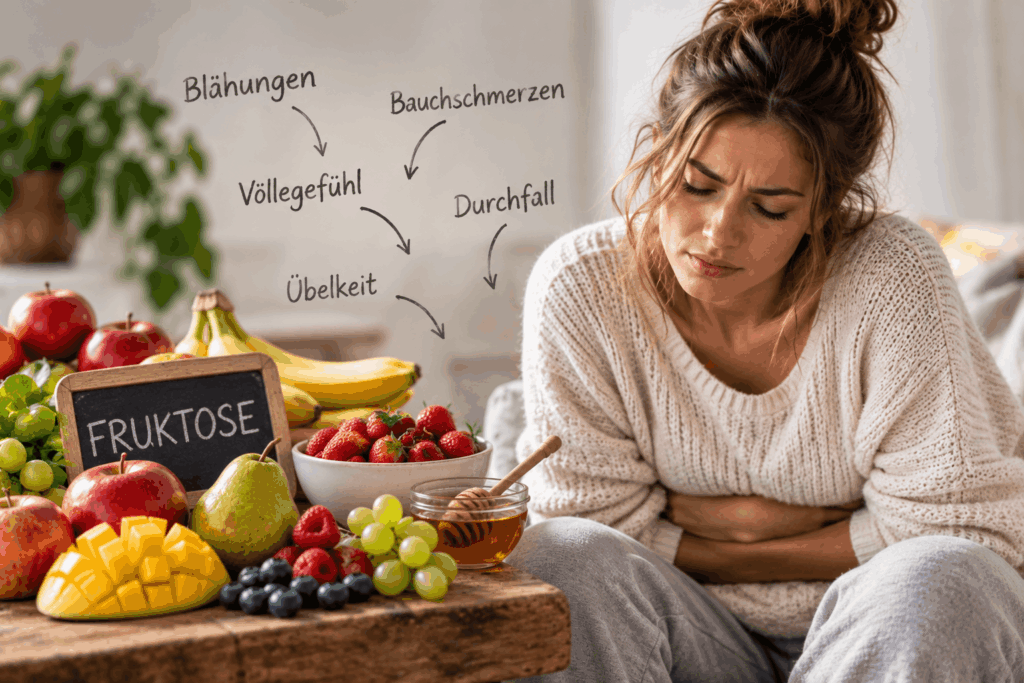
Typical fructose intolerance:
• Abdominal pain
• Cramps
• Feeling of fullness
• Nausea
• Diarrhea
• Flatulence (the kind that makes you open the windows straight away – you know exactly what I mean)
• Fatigue
• Brain fog
• Mood swings
But the craziest thing?
👉 The symptoms do not always come immediately.
Sometimes:
– 30 minutes later
– 3 hours later
– only in the evening
– or even the next day
This makes you constantly think:
"What caused it this time?! It was only a small portion…"
Welcome to the club.
You're not crazy.
You are simply not alone.
WTF fact (brace yourself):
Many affected people tolerate sorbitol EVEN worse than fructose – and sorbitol also blocks fructose absorption.
And where is sorbitol in it?
👉 In “sugar-free” chewing gum.
👉 In light products.
👉 In some vitamin supplements.
You don't know that yet?
Then congratulations – you've just discovered the root cause of 50% of your problems.
Why you do NOT have to do without – even if it feels like it
This part is important:
👉 You can enjoy again.
You just need to know how – and in what quantities.
Many foods work great.
Many combinations work great.
Your body doesn't react to fructose – it reacts to TOO MUCH fructose + wrong combination + wrong timing.
You don't need a completely fructose-free everyday life.
You need structure and a system.
Now let's build this step by step.
The 3-phase method that will change your life
Phase 1: The rest phase (2-4 weeks)
Here you do the reset.
Your intestines should shut down, relax and recover.
You consciously eat low fructose:
• Light pasta
• Rice
• Potatoes
• Zucchini
• Carrots
• Cucumber
• Eggs
• Yoghurt (low lactose is often better)
• Meat, fish, tofu
Many people think: “This is all boring.”
I'm telling you: no. This is the phase that brings you back enjoyment later.
Phase 2: The test phase – the most exciting time
Now things get interesting.
You don't just test foods – you test them in a controlled manner.
Example:
• 1 small portion of oatmeal → How do you react?
• ½ banana → How do you react?
• 5-10 blueberries → Is that possible?
• 1 tsp honey → Drama or relaxation?
Important:
👉 never test several new foods at the same time
👉 always the same time of day
👉 best in low-stress moments
Many of those affected suddenly notice:
“Oh my God, I can STILL eat fruit – just not a whole bowl.”
Phase 3: The enjoyment phase – your new, relaxed life
Goal:
• you know your portion sizes
• you know your triggers
• you know how to combine foods
• you can eat again without googling first
Example:
Earlier:
Apple → stomach drama.
Now:
Apple + quark + a few nuts → zero problems.
Because fat and protein slow down fructose absorption – and that's the game changer that almost nobody knows about.
The golden rules for relaxed eating
1. Never eat fructose “alone”.
Always combine with:
• Fat
• Protein
• Strength
This means that the fructose ends up in the intestine more slowly – and not all at once.
2. Eat slowly (yes, I know… difficult)
If you inhale your food like you're in a competition, your gut reacts offended.
3. Avoid stress (as much as possible)
Stress worsens fructose absorption – extremely.
Many people get symptoms not from eating, but from stress plus Eat.
4. Avoid sugar substitutes
Sorbitol is your final opponent.
Mannitol, xylitol, isomalt are often also critical.
5. Keep a symptom diary
After a week you will see patterns you never saw before.
Foods that you probably tolerate better than you thought
Well tolerated:
• Potatoes
• Rice
• Noodles
• Quark
• Mozzarella
• Carrots
• Spinach
• Cucumber
• Peppers (yellow and green are often okay)
• Kiwi (low fructose, high vitamin C)
• Strawberries (yes, really!)
• Blueberries
Medium:
• Banana (lots of glucose → often tolerated)
• Oranges
• Peach (small portions)
Critical:
• Apple
• Pear
• Mangoes
• Honey
• Watermelon
• Tomatoes in large quantities
Nobody believes me:
Strawberries have less fructose than a piece of apple.
Product recommendations (organic – without sounding pushy)
I'll only include things here that my community really uses:
1. Fructaid enzyme capsules
Perfect when you want to go out to eat and don't know what's in it.
Many people say: “Oh my God, if I had known that sooner…”
2. Glucose tablets
Glucose helps fructose be absorbed better.
Ideal before fruity meals.
3. Low fructose cookbook
With real recipes that taste and don’t look like “diet for aliens”.
4. Home self-test
Many people don't know whether they have FI or sorbitol intolerance – this test clarifies that.
Q&A – The most frequently asked questions
1. Can fructose intolerance go away?
She can get better!
If you calm your gut and adjust your diet.
2. Can I eat fruit again?
Yes – but smaller quantities and well combined.
Blueberries, kiwi and banana are often better than apple and pear.
3. Why do I sometimes have symptoms and sometimes not?
Fructose intolerance depends on:
• Stress levels
• Station wagons
• Portion sizes
• Intestinal flora
That's why it's a little different every day.
4. Is chocolate allowed
Dark chocolate: often yes.
Whole milk: sometimes.
White chocolate: rather difficult.
Tip: Always eat after a main meal.
5. Are dietary supplements useful?
Yes – enzymes like Fructaid can provide extreme relief.
6. Will it ever get easier?
Yes.
It's annoying at the beginning, but once you understand your body, you can live more relaxed than you do now.
How to make your everyday life low in fructose – without giving up
Breakfast ideas:
• Porridge with quark and a few blueberries
• Scrambled eggs with vegetables
• Spelled bread with cheese
Snacks:
• Nuts
• Rice cakes
• low-lactose yogurt
Lunch/evening:
• Salmon with potatoes
• Chicken with rice
• Vegetable pan
Sweet:
• Dark chocolate
• Pudding
• small portion of dark chocolate after eating
Enjoyment is ALWAYS possible – all you need is your personal blueprint.
Conclusion: You are not broken – you are simply sensitive
Oh my God, I know exactly how overwhelming this is at first.
You feel like you have to give up everything – and no one understands you.
But the truth is:
👉 You don't have to do without.
👉 You just have to understand what YOUR body needs.
👉 Once you know the system, everything becomes easier.
👉 You can enjoy again – really!
And no one believes me, but many sufferers feel significantly better after just 2-3 weeks.
Notice: The content on this website is based on personal experiences and research and does not constitute medical or therapeutic advice. If you have any health or psychological complaints, please contact a doctor or a qualified specialist!