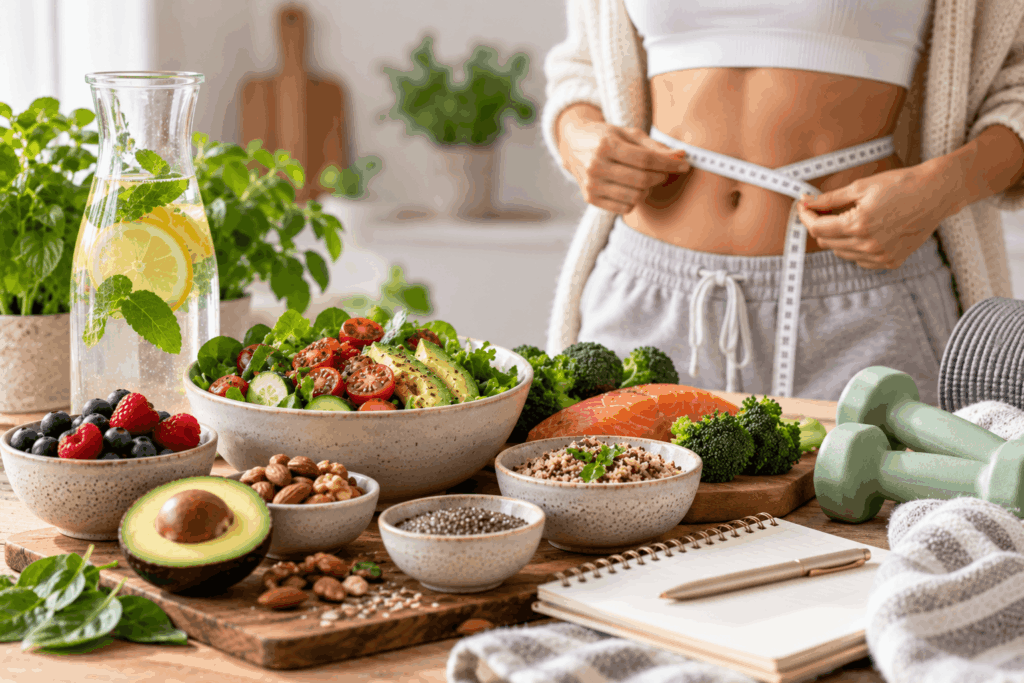
Do you want to lose weight – but without strict diets, complicated rules or hours of workouts? The good news: This is possible. Because it's often not big changes, but rather small, consistent adjustments in everyday life that make the difference. In this article you will find 10 practical tips that will help you achieve your desired weight step by step – healthy, sustainable and without sacrifice.
1. Drink water – the easiest metabolism booster
Drink a large glass of water before every meal. Why? Because it not only fills you up, but can also boost your metabolism by up to 30% – at least for a while, as studies show. Drinking enough water also helps you avoid cravings, as thirst is often confused with hunger. The guideline is 30-40ml of water per kilogram of body weight daily – depending on activity.
Tip: If you find water too boring, you can improve the taste with lemon slices, cucumber, mint or ginger – without any calories.
2. Mindfulness when eating: Your body knows the answer
Conscious eating, also known as “mindful eating,” can fundamentally change your eating habits. Sit down, eat without distractions, and enjoy every bite. People who eat mindfully stop eating sooner because they are more aware of their natural satiety signals.
What you should avoid: Eating in front of the TV or on your cell phone. Studies show that people consume an average of 10-25% more calories.
3. More exercise – even without a sports program
You don't have to run a marathon to lose weight. It is much more effective to integrate exercise into your everyday life. The so-called “NEAT” (Non-Exercise Activity Thermogenesis) describes all the calories you burn outside of exercise – for example when walking, climbing stairs or cleaning.
Example: If you walk 2,000 more steps every day, you will burn over 700 additional calories per week – that's about the equivalent of an entire meal.
4. Regular meals stabilize your blood sugar
Irregular eating times often lead to blood sugar fluctuations – with food cravings as a result. Three balanced main meals per day with healthy snacks in between (e.g. nuts, fruit, natural yogurt) will help you better control your hunger and prevent uncontrolled snacking.
Extra tip: Pay attention to protein-rich snacks – they keep you full longer than carbohydrate-heavy snacks.
5. Protein: The filler among nutrients
Protein-rich foods not only help you feel full, but also protect your muscle mass when losing weight. And more muscles mean a higher basal metabolic rate – i.e. more calorie consumption when resting. Good sources of protein include: B. Quark, lentils, eggs, tofu, fish or chicken.
Guideline: Approximately 1.2-1.5g of protein per kilogram of body weight daily, or more if you are physically active.
6. Sleep – the often underestimated weight loss tool
Poor or too short sleep upsets the hormonal balance: Ghrelin (the hunger hormone) increases while leptin (the satiety hormone) decreases. The result: more appetite, less impulse control, more desire for sweets.
Tip for better sleep: Reduce screen time in the evening, stick to a fixed bedtime and relax at least an hour before going to bed (e.g. with reading or a calming tea).

7. Reduce sugar – step by step
Excessive sugar consumption not only promotes weight gain, but also negatively affects your insulin levels. Instead of eliminating sugar completely (which often leads to cravings), reduce it slowly. Replace e.g. B. sweetened drinks with water or fruit tea and bake with bananas or dates instead of refined sugar.
Caution: Sugar is also hidden in supposedly “healthy” foods such as muesli bars, fruit yoghurt or ready-made sauces – it’s worth taking a look at the list of ingredients.
8. Plate trick: Eat less through optical illusion
Our brain eats with us – and is easily deceived. On a small plate, a normal portion appears larger and therefore fills you up quicker. On a large plate, the same amount seems smaller, which means we often take more.
Practical: Use smaller bowls and plates – and eat slowly. This gives your body time to develop a feeling of satiety.
9. Calorie trap drinks – this is the easiest way to save money
Many people underestimate the calories they drink. A glass of cola has around 100 kcal, a latte macchiato up to 250 kcal depending on the size. Smoothies or fruit juices are also considered “healthy”, but often contain high amounts of fructose.
What works better: Water, unsweetened tea, black coffee or infused water with natural flavors. This means you can save a lot of energy every day without having to sacrifice anything.
10. Patience and consistency – the key to long-term success
Losing weight is not a sprint, but a marathon. There will be days when things don't go perfectly – that's normal. What is important is not perfection, but consistency. If you make 80% of your decisions healthily, a piece of cake is absolutely okay.
Think in weeks and months, not days. And also celebrate small successes: a better body feeling, more energy, a more conscious approach to food – these are real progress.
11. Food diary: Mindfulness through writing things down
A food diary (handwritten or digital) can help make unconscious eating habits visible. Many people only realize when they write down how often they eat on the side or grab snacks for emotional reasons. You don't have to document everything forever – just a few days can bring aha moments.
Tip: I like to use it for this this food diary*
Conclusion: Small steps, big impact
Losing weight doesn't have to be complicated or strenuous. With small, consistent steps – more water, better sleeping habits, conscious eating and more exercise in everyday life – you will achieve your goal sustainably. Remember: perfection is not necessary. Every little progress counts and brings you closer to your desired weight. With patience, consistency and self-confidence, you will not only go through life easier, but also happier and more energetic.
Notice: The content on this website is based on personal experiences and research and does not constitute medical or therapeutic advice. If you have any health or psychological complaints, please contact a doctor or a qualified specialist!